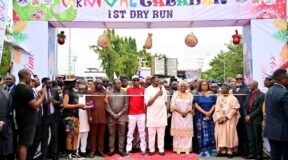
Recently, His Lordship Rt. Rev. Prof. Nneoyi Onen Egbe, Bishop of the Diocese of Calabar (Anglican Communion) spoke to journalists in an interview where he bear his mind on a number of state and national issues. Our Correspondent, Nick Nwaneri was lucky to be among those privileged to have an encounter with the Revered Servant of God, Bishop Egbe. Below are his views on both state and national issues. It is a MUST read. Relax and savour the interview during the Eleventh Synod.
Question: From the peak of Academics to the peak of religion, Bishop Egbe, how do you feel, Your Lordship?
His Lordship: I see myself as a man whom God has favoured greatly. One who has been blessed to bless, saved to save, and made free to show others the way to freedom. All that I am is by the Grace of God.
Question: What is your assessment of the recent call by the immediate past Governor of Kaduna State; Mallam El Rufai for an Islamic Republic of Nigeria?
His Lordship: In my opinion, people who only focus on their side of human existence should never be taken seriously. Mallam El Rufai can create whatever he desires with his family, certainly NOT NIGERIA. Nigeria is too big for such to happen. When statements are made like this, one need not forget that one’s listeners also have the right to declare their own republics. Such unguarded utterance is meant to fester bad blood among the stakeholders in the Nigerian project. My worry is that someone makes such statements and is still walking freely in the streets of the country. If this statement were made from another sector of our polity, many voices would have arisen to vilify him. Truth be told, if he calls for an Islamic Republic, we also call for a Christian Republic, and then republics for all other religious sentiments. Such talk is to create diversion for them, politicians, to continue stealing our inheritance while we are busy debating responses to their statements.
Question: During Moments of Social Unrest like the #EndSars, the Government will always seek the assistance of religious leaders in appealing to the people for Peace, how do you describe the relationship between the government and Religious Leaders in Cross River State?
His Lordship: We have a new government in place now which we believe will be more open to input from leaders of thought in the state. Early engagement with religious leaders will provide the platform for a more people-oriented approach to governance, and the Prince Otu-led government of Cross River state has shown early signs of interest in her people. The practice of only running to religious leaders when there is a crisis is manifest evidence of a government that does not value her people and would only pay attention to them when threatened. We are watching.
Question: No doubt Anglicanism is not yet deep-rooted in Cross River State. Furthermore, Cross River is a State of great diversities; from the highlands of Obudu to the creeks of Bakassi, how has this affected evangelism?
His Lordship: Of a truth, Anglicanism is not yet deep-rooted in Cross River State, but we can say categorically that Anglican Church has come to stay. The diversities of Cross River State favours the growth of the church because the Anglican Church is a Communion of diversities, races, backgrounds, ideologies, ethnicities and so on. The church is owned by everyone and no one! We are all co-owners and have equal opportunities. When communities receive our ministry and missionaries, they find people who are willing and eager to become part of these communities.
Question: What are the major challenges facing the Anglican Church in Cross River State?
His Lordship: Major challenges! There are many but not unexpected. The diversities mentioned earlier present a challenge. Communication problems as a result of the many languages in the state. We also face the challenge of the topography, especially in the mountainous areas, some of which do not have access roads. Of course, the very size of the Diocese is a challenge. The lack of indigenous workers is also an issue, though this is gradually shifting. Do we need to mention the all-important issue of money? These are some of our challenges, but again, they are not unexpected.
Question: How would you describe the state of the Nation, in view of the recent removal of petroleum subsidy and the proposed removal of subsidy on subsidy on electricity?
His Lordship: Many Nigerians have been aware of the level of corruption and criminality surrounding fuel subsidy over the years. No right-thinking person will support this. While we commend its removal, we are very opposed to the lack of adequate preparation for the action. And coming on its wake, is the increase in electricity tariff. Again, what has the government put in place to ameliorate the pains borne by Nigerians? I heard someone saying recently that the suffering is for a while, and Nigerians will soon enjoy! That was what they said when SAP was introduced. And for every one of similar decisions of government, the Nigerian masses have borne the brunt thereof. See, I have come to the conclusion that the people that rule us do not take decisions for the good of the nation and her people, but for their own interest. An example is the former President shelving the removal of fuel subsidy SO THAT HIS PARTY WILL WIN ELECTIONS! Is there any reason to believe that these subsidy removals are not meant to feed some few people’s greed? I tell you the truth, at the rate we are going, the government will soon make Nigerians pay for the air we breathe! .
Question: Has Democracy been a blessing to the ordinary Nigerian or a curse?
His Lordship: There is no democracy in Nigeria. We have civilians in government, but it is definitely not a democracy. We will be able to answer this question when we have a democracy in the country. If you ask what we have, I will call it a KLEPTOCARY! A government of “Snatch it, grab it and run with it!
Question: The theme of your Synod is “SEE” What are the expectations of the Diocese at the end of the Synod?
His Lordship: We expect that the Lord will “open” and expand our ability to see things as he sees them. We have promises of God’s working among us, and the varied provisions he has made for our success in the Diocese. But not many of us seem to understand the depth of God’s provision, presence and empowerment, available in this Diocese. Our expectation is that we will come out of Synod with a renewed awareness of the wealth within us and around us, that will propel us towards achieving the mandate of God upon our lives as individuals and as a Diocese.
Furthermore, he said “Other issuesDemocracy can only be guaranteed in Nigeria if the electoral body is allowed to be truly independent. We need to very quickly determine a route for the appointment of the Chairman of INEC, which must be a process devoid of any political connections and linkages. We may recall that there were efforts by one regime to use a pool of traditional rulers for this purpose, but we do not know why this failed”.
Question: Is Nigeria ready for Federalism?
His Lordship:Nigerian can only thrive as a Federal State. Over the years the calls for the practice of true Federalism have been very loud. It is very unfortunate that we have leaders who have become deafened by the greed for power, affluence and control that there is no desire nor moral will to allow the true aspirations of Nigerians to prosper. If it will take restructuring to arrive at it, then we must be willing to make it happen. The encouraging thing in the Nigerian polity is that no true Nigerian wants to see the end of the great country. We appeal to those in power, to engineer the emergence of a truly Federal Republic of Nigeria..?