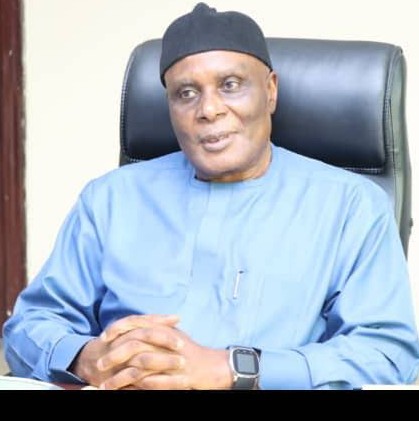
It is with a profound sense of nostalgia, gratitude and renewed hope that I stand here today. There are occasions one attends as a guest, and there are occasions one attends as a participant. But there are a few occasions in life when one stands in a place and is confronted by one’s own history. For me, this is one of those occasions.
My relationship with the Nigerian Chronicle did not begin today. It began in August 1978, when, as a young man completing my National Youth Service, I saw an advertisement for the position of economics editor with the newspaper. I applied. and was successful, that was how my journey with the Nigerian Chronicle began.
I started work under Ray Ekpu, who was then the editor. The General Manager was Chief Efiong Essien, while the Chairman of the Board was Mr. Nyong Udoeyop. I worked with Mrs Kate Okon in the Features Department and had a regular Friday column, Business with Clement Ebri. I also wrote features and editorial opinions from time to time. Within about a year, I became the Features Editor after Kate Okon left for Cross River Radio. Then, in 1980, when Ray Ekpu left for the Sunday Times, he handed over to me as Acting Editor, despite the fact that there were more than ten people ahead of me interms of seniority.
It was a remarkable vote of confidence in a young journalist. I served as Acting Editor for about six months before I eventually resigned. But I have taken you back to those early years for a reason. The Nigerian Chronicle of that era was not merely a newspaper. It was an institution.
THE CHRONICLE WE BUILT
The level of activity was extraordinary. The intellectual quality was high. The journalism was vibrant. The output was impressive. Our regular print run was, at one point, about 80,000 copies daily, and on some occasions it rose to approximately 120,000 copies. We had correspondents across Nigeria-in Ibadan, Sokoto, Lagos, Port Harcourt and other major centres. We produced first and second editions. We produced Sunday editions and once in a while, we produced special editions. Our delivery vans moved copies across the country.
I particularly remember the 1979 elections, when significant stories warranted an evening edition. That was the kind of newspaper the Chronicle was. We had some of the finest minds in journalism working within its walls. We even had a magazine, Quest Magazine. The Chronicle had attained a remarkable pedestal.
But perhaps what distinguished that era most was the confidence with which journalism was practised.
There was considerable editorial freedom. We could criticise the government in power. We could criticise legislators. There were occasions when those in authority were unhappy with what we published. But the newspaper survived, and journalism continued to serve its purpose. And throughout it all was the simple but profound philosophy captured in the Chronicle’s motto:
TRUTH AND SERVICE.
Those were not merely words on a masthead. They were an editorial responsibility. They were a professional ethic. They were a covenant with the public. And when I speak about the Nigerian Chronicle today, I do not speak as someone who merely remembers it. I speak as someone who lived it. The Chronicle was good to me. It gave me a platform. It opened doors. It exposed me to possibilities beyond the immediate environment.
In 1979, the Chronicle sent me to the United States as one of ten Nigerian journalists selected for that programme. I was attached for about a month to the Milwaukee Courier, and I benefited immensely from the editorial lessons and professional exposure I received there.
That experience reinforced something I had already begun to understand: A newspaper is more than a business. It is an institution for building people, preserving history and giving a people a voice. The Chronicle provided that platform for me. I covered major events, including ECOWAS engagements, and had the privilege of interviewing some of the most distinguished Nigerians of that era.
Among them were Mr. Ola Vincent, Governor of the Central Bank of Nigeria, and Chief Gamaliel Onosode, the renowned boardroom guru who served as Chairman and Chief Executive of Nigerian Acceptances Limited and chaired several major companies. That was the Chronicle I knew. It was a place where young journalists could learn. A place where ideas mattered. A place where journalism could open doors. A place through which Cross River could speak to Nigeria.
THE CHRONICLE WE LOST
But institutions, just like human beings also, experience seasons. There came a period when the quality and standards began to decline. Some of the most experienced and talented hands left, and unfortunately, they were not always adequately replaced. Over time, some of the intellectual and professional strength that had distinguished the organisation began to diminish.
Then came 2020. The #EndSARS crisis inflicted devastating damage on the Chronicle’s premises. But the tragedy went beyond the destruction of a building. We lost equipment. We lost books. We lost records. We lost newspaper cuttings.
We lost pieces of an institutional memory that belonged not only to the Chronicle, but to Cross River State. And this is why I consider the restoration of the Chronicle’s library and archives particularly important. A newspaper that has documented the history of a people for decades cannot afford to lose its own history.
Our archives are not simply old papers. They are the memory of a people. Yesterday, during an interview, I appealed to Cross Riverians to look into their personal and institutional archives. I have donated some books and newspaper materials myself. But I believe we can and should do more.
If you have old copies of the Chronicle, photographs, newspaper cuttings, documents or other materials connected to its history, bring them forward. Let us reproduce them. Let us preserve them. Let us rebuild the archives. Let us restore what was lost. Because when a people lose their records, they lose part of their collective memory. And when collective memory disappears, history becomes vulnerable to distortion and forgetfulness.
THE CHRONICLE WE MUST NOW REBUILD
Today, however, I stand here not in lamentation, but in hope. I remember that when I became Governor of Cross River State, I was sworn in on the 2nd of January 1992. About eight days later, by around the 10th of January, I was already at the Chronicle. I went there because my interest in the institution did not end when I left its newsroom. It had become part of me. I made observations. I offered suggestions. And I supported the organisation.
We brought in satellite dishes, Apple computers, cameras and other equipment. We expanded and reorganised the place. I did what I could because I understood the institution’s potential. That is why today’s occasion is particularly meaningful to me. When I spoke to His Excellency, Senator (Prince) Bassey Edet Otu, about the need to revive the Chronicle, the idea resonated with him. He became receptive to the vision of bringing this important institution back to life.
Today, we are witnessing the fruit of that commitment. I therefore wish to commend His Excellency for the interest he has demonstrated and for the investment that has gone into this revitalisation. I also commend the management and staff of the Cross River State Newspaper Corporation for the work that has brought us to this point.
But let me make one thing very clear: This commissioning must not be the conclusion of the revival. It must be the beginning of a new chapter. We must not simply restore the Chronicle of yesterday. We must build the Chronicle of tomorrow.
The world has changed. The media landscape has changed. The way people receive, consume and share information has changed. But change in technology does not mean the death of journalism, nor does it have to mean the death of print. I have heard it said that “the faintest ink is better than the sharpest memory.” There is considerable wisdom in that.
Someone may ask, in this digital age: “Why print a newspaper when everything is already on the phone?” My answer is simple. Try handing your grandchildren your phone thirty years from now and asking them to find today’s news. You may first have to explain where the charger is. But hand them a newspaper cutting, and they only need a pair of eyes. Digital is immediate. Print is archival. We should therefore not treat print and digital as enemies. They are not.
Technology should not become the undertaker of the newspaper. It should become its new vehicle. The Chronicle must embrace this reality. It must strengthen its digital presence. It must tell stories through print, online platforms, social media, video and other emerging forms of communication. It must attract and train a new generation of journalists. It must invest in investigative journalism. It must maintain professional independence and credibility. It must expand its reach.
And perhaps, as we look to the future, we should begin to consider how the Chronicle can once again establish a strong regional presence. The question before us should therefore no longer be:
“How do we save the Nigerian Chronicle?”
The more important question is:
“How do we reposition the Nigerian Chronicle to matter again?”
That is the challenge.
And I believe it is achievable.
A CALL TO COLLECTIVE OWNERSHIP
Government can provide infrastructure. Government can provide equipment. Government can create the enabling environment. But institutions ultimately survive because people believe in them. That is why I appeal to Cross Riverians-government officials, journalists, academics, business people, professionals and every well-meaning citizen-to take ownership of this revival. Support the Chronicle.
Read it. Advertise in it. Write for it. Challenge it when necessary. Hold it to high professional standards. And give it the opportunity to serve you. Because the Chronicle must not merely report what happens in Cross River. It must help shape the conversation about what Cross River can become.
This is particularly important at a time when our society is increasingly defined by the speed of information. Speed, however, must never replace accuracy. Visibility must never replace credibility. Technology must never replace responsibility. And freedom must always be accompanied by professionalism. The Chronicle must therefore reclaim its place as a trusted institution of public communication.
TRUTH AND SERVICE – THE LEGACY WE MUST PRESERVE
As I stand here today, I cannot help but reflect on the extraordinary journey of this institution. I came here in 1978 as a young journalist. I became Features Editor. I became Acting Editor. The Chronicle sent me abroad. It gave me opportunities to cover important events. It gave me access to people and institutions I might otherwise never have encountered.
And years later, I became Governor of the same state in which the Chronicle had given me my professional beginning. For me, therefore, this is deeply personal. The Chronicle was once a flagship. It was once a newspaper people waited to read. It was once a training ground for brilliant minds. It was once a platform through which Cross River spoke to Nigeria.
I believe it can become all of that again and even more. But that will require courage. It will require professionalism. It will require investment. It will require innovation. And above all, it will require a return to the values upon which the institution built its reputation
:
TRUTH AND SERVICE.
Let us therefore not kill the print media simply because the digital era has arrived.
Let us synchronise the two.
Let us make them stronger together.
Let the printed page preserve our history.
Let the digital platform extend our reach.
Let journalism remain fearless, responsible and credible
.
Let the Chronicle once again become a place where young journalists learn, where ideas are tested, where public institutions can be scrutinised and where truth can be told responsibly.
CONCLUSION
Today, we are not merely commissioning a renovated building.
We are commissioning the restoration of a legacy.
A legacy that began more than five decades ago.
A legacy that shaped generations.
A legacy that survived difficult seasons.
A legacy that was battered but not destroyed.
And a legacy that today has been given another opportunity to rise.
We have brought the Chronicle back to life.
The responsibility now is to give it a life worthy of its history.
May the presses roll again.
May the pages speak again.
May the voices of our journalists be heard again.
May the archives be restored.
May a new generation of journalists find their voice here, just as some of us did many years ago.
And may the Nigerian Chronicle once again tell the story of Cross River-not only to Cross Riverians, but to Nigeria, Africa and the world.
This time, let that story travel farther than it ever has before.
Let it be a story of truth.
Let it be a story of service.
Let it be a story of resilience.
And let it be a story of a people who refused to allow their history to disappear.
Long live the Nigerian Chronicle.
Long live the Cross River State Newspaper Corporation.
Long live Cross River State.
Long live the Federal Republic of Nigeria.
Thank you, and God bless you all.